
How Contemporary Art Creates Visual Tension in Luxury Interior Design
Luxury interior design has always been associated with balance. Walk through the pages of Architectural Digest, Dezeen or The World of Interiors and you will find beautifully composed spaces where every finish, material and piece of furniture appears to sit exactly where it should. Everything feels considered. Everything feels calm.
Yet the interiors that stay with us long after we leave them have something else in common. Beneath that sense of calm lies a carefully composed layer of visual tension. It is the subtle relationship between harmony and contrast that stops a room from feeling predictable. It encourages the eye to pause, explore and return, often without us consciously realising why.
Interior designers understand this instinctively. A room that is perfectly balanced can sometimes feel complete too quickly. There is nothing left to discover. The most successful interiors rarely strive for perfection alone. Instead, they create moments of curiosity through carefully judged contrast, negative space, asymmetry and material variation. The result is a room that feels lived in rather than staged.
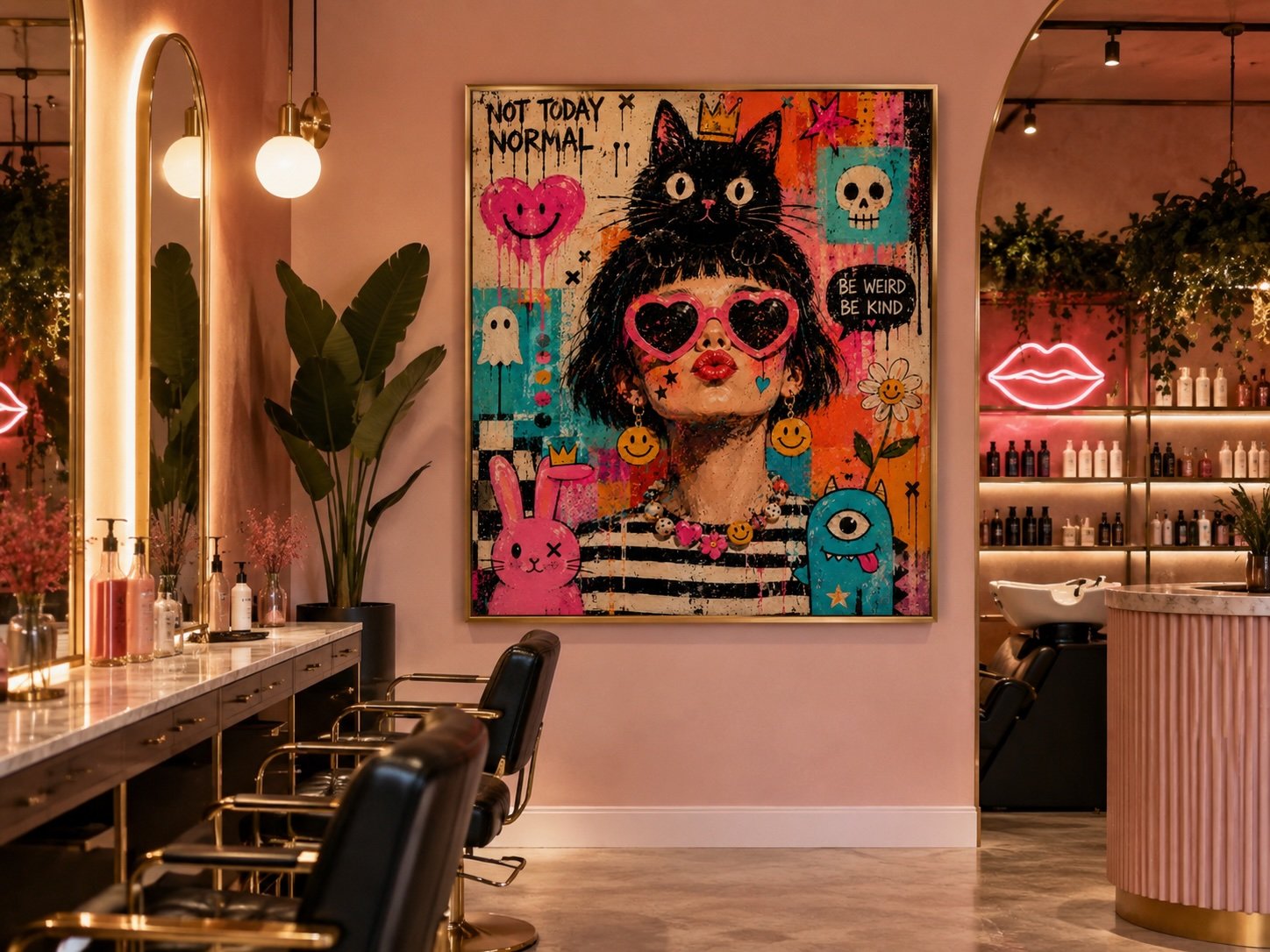
Not Today’s Normal by Ivy Hex for Landson Studios
What Is Visual Tension in Interior Design?
Visual tension is the quiet dialogue between opposing elements within a space. It might be a polished marble floor meeting a rough plaster wall. It could be an antique cabinet standing confidently beneath contemporary architecture or a sculptural light fitting introducing movement into an otherwise restrained room.
Rather than creating conflict, these contrasts create interest. They encourage the eye to move naturally through an interior, discovering relationships between objects instead of seeing everything at once. Designers often refer to this as creating rhythm within a space, allowing different elements to lead the viewer from one focal point to another.
This principle has existed for centuries. Architects have long understood that beautiful spaces depend as much on what is left out as what is included. The Japanese philosophy of wabi-sabi celebrates imperfection, irregularity and the quiet beauty found in natural ageing. Rather than pursuing flawless symmetry, it values authenticity and character. Belgian designer and curator Axel Vervoordt has drawn on these ideas throughout his work, creating interiors that feel deeply calm without ever becoming sterile. His projects demonstrate that simplicity becomes far more engaging when it allows room for contrast and texture to emerge naturally.
Why Negative Space Matters
Negative space is often misunderstood as empty space. In reality, it performs one of the most important roles in luxury interior design.
Without space around them, even exceptional pieces begin to compete for attention. Furniture, lighting, architecture and artwork all benefit from moments of visual pause. These quieter areas allow the eye to rest before moving naturally towards the next point of interest.
Japanese architect Tadao Ando has spent decades exploring this relationship between architecture, light and emptiness. His buildings are remarkably restrained, yet they never feel lifeless. Natural light, shadow and proportion become materials in their own right, creating atmosphere without relying on decoration. The absence of visual clutter allows every remaining element to carry greater significance.
The same principle applies inside the home. A carefully edited room often feels richer because every object has been given the space to be appreciated.
Why Symmetry Is Only Half the Story
Symmetry creates order. It gives us a sense of stability and calm because our brains naturally recognise balanced compositions.
Psychologists studying Gestalt theory observed that people instinctively search for patterns and organise visual information into coherent forms. We enjoy order because it helps us understand what we are looking at.
Yet perfect symmetry can also become predictable.
Many of the world's leading interior designers introduce subtle asymmetry to prevent a room from feeling static. A single oversized chair might offset a carefully arranged seating area. An unexpected material might interrupt an otherwise consistent palette. These decisions often appear effortless, but they are carefully composed to keep the room visually alive.
The goal is not imbalance for its own sake. It is to create enough variation that the eye remains engaged without the room ever feeling chaotic.
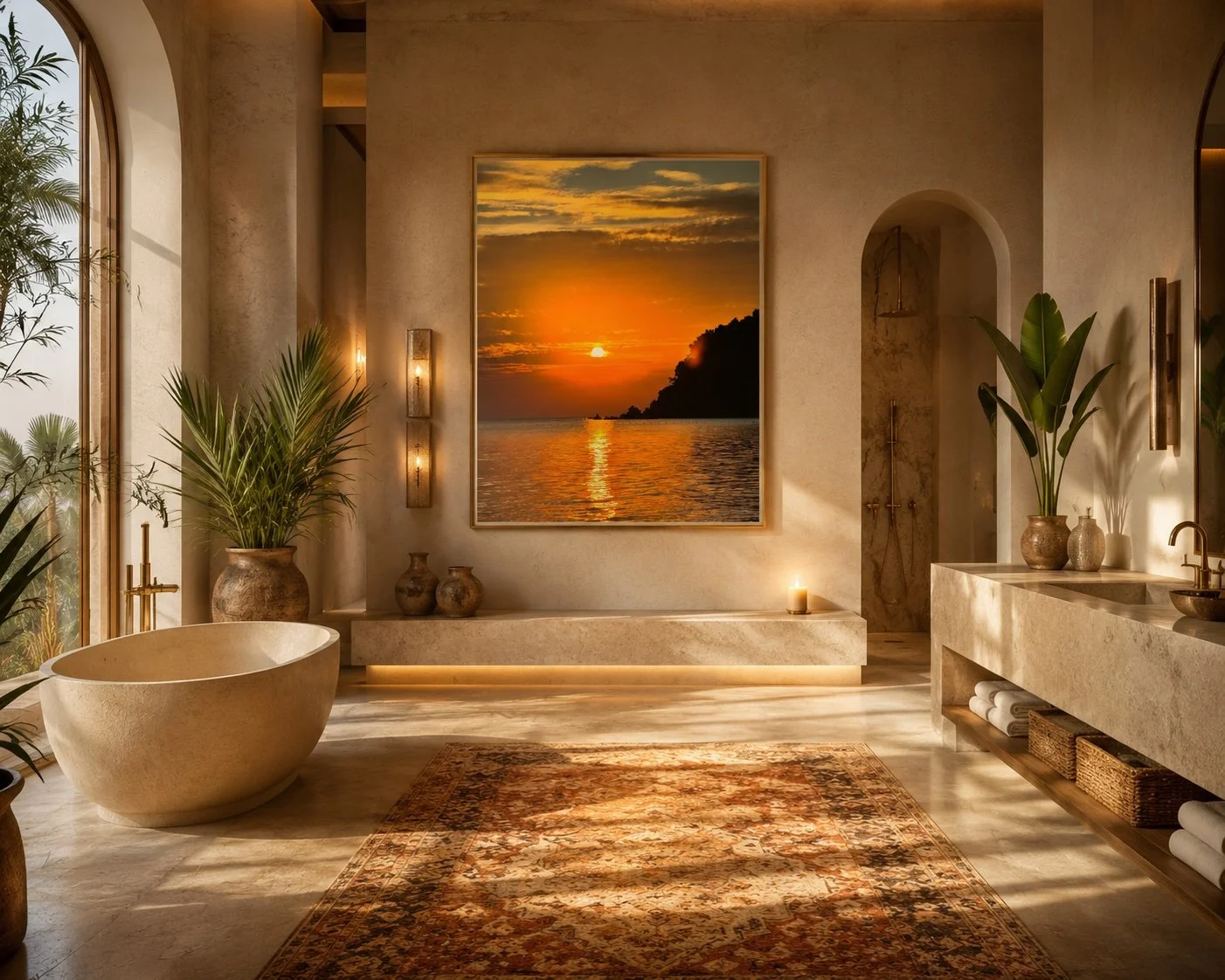
Ocean Gold Photography Print by Dakota for Landson Studios
Why Contemporary Art Plays Such an Important Role
This is often where contemporary art becomes one of the most powerful elements within an interior.
Artwork has the unique ability to introduce complexity without disrupting the overall harmony of a room. A single piece can introduce colour, movement, texture or emotion into an otherwise restrained scheme. More importantly, it gives the viewer somewhere to pause.
Unlike furniture, artwork is rarely chosen purely for function. It exists to create atmosphere, provoke thought or establish identity. In well considered interiors, it often becomes the visual anchor that quietly connects architecture, furniture and materiality into a single composition.
Perhaps this explains why many of the most memorable luxury interiors do not simply display art. They give it room to breathe. Museums have understood this principle for generations. They rarely fill every available wall because negative space allows each work to command attention without competing with its surroundings.
Designing Rooms That Reward a Second Look
One of the most interesting characteristics of exceptional interior design is that it reveals itself gradually.
The first impression might come from the architecture. A second glance notices the texture of the materials. Over time, smaller details begin to emerge through the careful relationship between light, objects and artwork. Every visit offers something new.
This is rarely accidental. Designers use rhythm, contrast, focal hierarchy and negative space to slow the way we experience a room. Rather than overwhelming us with information, they encourage us to spend time looking.
Perhaps this is why so many carefully designed interiors remain memorable for years after we have visited them. They do not rely on trends or spectacle. They reward curiosity.
Final Thoughts
Luxury interior design is often described in terms of materials, craftsmanship and investment. While these qualities certainly matter, they are rarely what makes a space unforgettable.
The interiors that stay with us are those that balance harmony with curiosity. They understand that contrast is not something to eliminate but something to compose carefully. Negative space, asymmetry, rhythm and focal hierarchy all contribute to that experience, allowing every object within a room to feel intentional.
Contemporary art naturally becomes part of this conversation because it introduces another layer of meaning. It creates moments of pause, invites interpretation and often becomes the element that transforms a beautiful room into one that people remember.
The finest interiors are not perfect.
They simply give us a reason to look a little longer.
Curated, Not Chosen by Algorithm
The works we represent are selected for their ability to reward repeated viewing and become lasting focal points within an interior. Explore our latest collection and discover contemporary art that feels as considered as the spaces it inhabits.